
Verified by the Cebu City Tourism Commission · every fact names its source below
Sinulog
Sulog is the Cebuano word for a current in water. Sinulog is what moves like one. The dance is a step forward, a step back, two forward, in time with drums, the body swaying the way a river pushes against the tide. It is a dance about water, from a people who lived on it. Long before there was a parade, there was the step.
The story told in Cebu is that the dance was already here when the fleet arrived in 1521, and that the women of Humabon's court danced it in front of the Christ Child image the Spaniards gave the queen. Whether or not that telling is exact, the movement is far older than the festival that now carries its name, and it belongs to the same current that runs through everything on this site: the sea road, the balangay's flexing hull, the harbour that received the world.
The festival
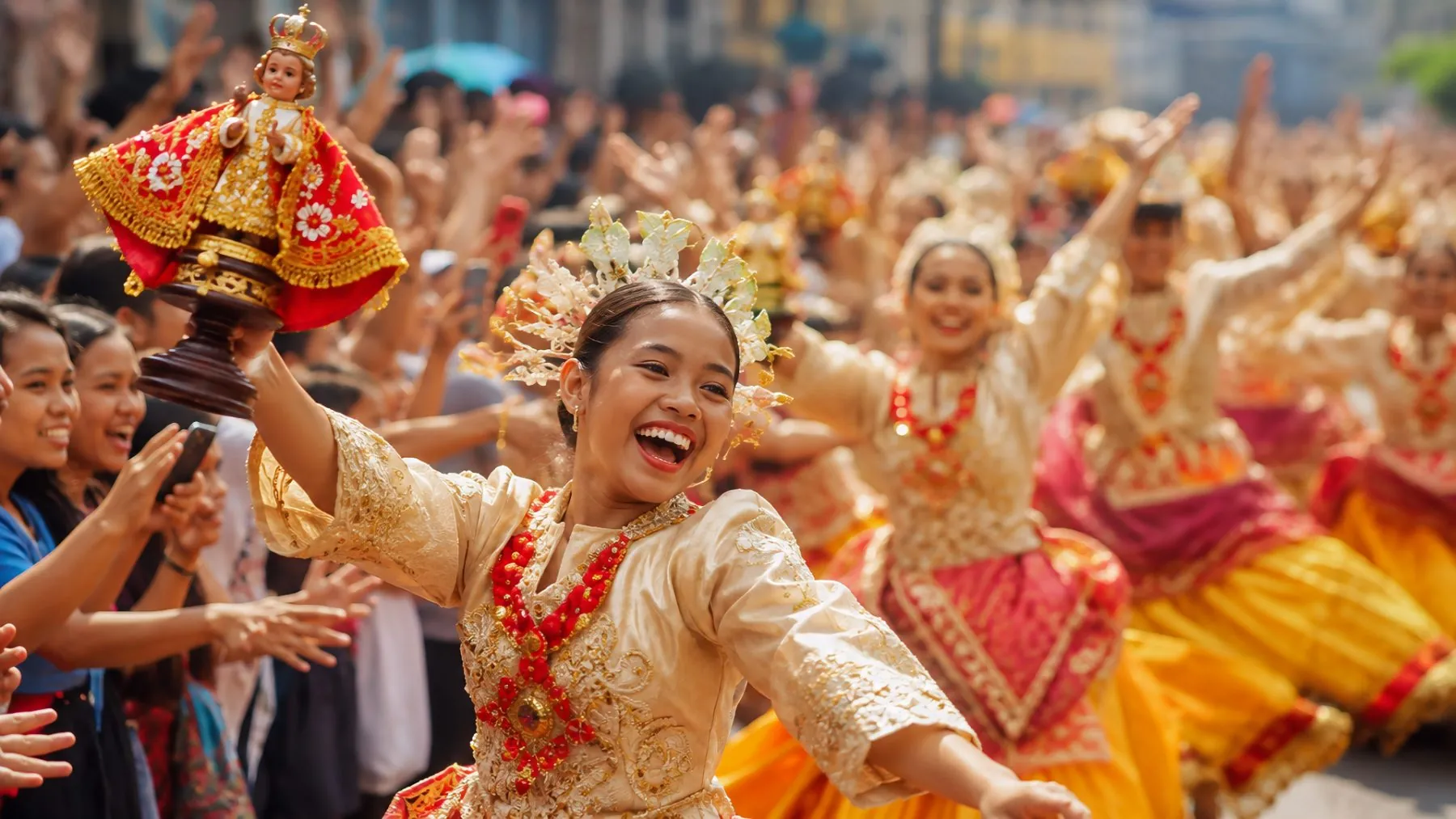
The Sinulog Festival as the world knows it began in 1980, when David Odilao Jr., then regional director of the Ministry of Sports and Youth Development, organised the first street parade of dancers in the sinulog step. It grew within a decade into one of the largest in the country. Today it is held on the third Sunday of January and fills the city for a week before that: street parties on every avenue, a film festival, a beauty pageant, and on the Sunday itself a grand parade of contingents from across the Visayas and Mindanao that runs from morning to night. The fluvial procession that opens the weekend on the channel belongs to the feast, not to the festival.
The Sinulog Foundation, which runs it, describes it as a festival, a Mardi Gras. It revolves around the devotion to the Santo Niño, and it is distinct from the religious observance: the procession and the fluvial parade belong to the feast, which belongs to the Basilica and to the faithful. The festival is a celebration of Cebuano identity in costume, dance and drum, and it belongs to everyone, whatever they believe.
Still, at the centre of every contingent's dance, held high by the lead dancer, is a small crowned figure: the Santo Niño, the image the fleet left here in 1521. Nobody in the parade needs that explained. You will feel it before anyone tells you, in the hush that comes over the crowd when the drums stop and the figure is raised. That is the moment the festival keeps for itself.
Pit Señor
The shout you will hear a thousand times that week is Pit Señor, short for sangpit sa Señor, a call to the Lord. It is shouted at parades, at parties, at the airport and from jeepneys, by the devout and by people who simply love the week. It has become the greeting of the season, the way bai is the greeting of the city.
Coming up
The City’s official events calendar appears here as events are published.
Sinulog 2027
The next Grand Parade is on Sunday, 17 January 2027, at the Cebu City Sports Center, under the Sinulog Foundation's theme One Beat. One Dance. One Vision. Mayor Nestor Archival has asked for a Sinulog that is grand and sustainable at once, and the Foundation has backed him: the parade keeps its home, the route may extend to ease the crowds, and drone shows are being weighed as a cleaner alternative to fireworks.
Contingents register with the Sinulog Foundation, not with this site; the window opened in October 2026 and closes at the end of November.
The city's year
Sinulog is the start of the City's year, not the whole of it. These are Cebu City's own events, month by month, as the Commission's calendar has them.
- January: Sinulog, on the third Sunday; the Balik Cebu homecoming; the New Year countdown.
- February: the Chinese Heritage Fair in the old Chinatown.
- March: the Farm to Table food trail; a Spanish Heritage Fair for the circumnavigation, planned for 2027.
- April: the Tourism Summit, for the trade; Sports Tourism Month, with mountain biking and kite-flying at the South Road Properties.
- May: Flores de Mayo, a devotional walk from the Cathedral to Patria.
- July: the Great Cebu Sale.
- September: Tourism Month, and the Cebu Dragonboat Festival.
- November: the Cemetery Tour and the Kalag-Kalag Run, around All Saints' and All Souls'.
- December: Pasko sa Plaza, Christmas at Plaza Independencia.
With our partners: Gabii sa Kabilin, the Ramon Aboitiz Foundation's heritage night, held every year since 2007, when the city's museums stay open late. Its 2026 edition was held on 2 October. An evening light-and-sound show at Fort San Pedro is in the City's plan; it will appear here when it has a date.
Tourism Month
September is the City's tourism month, built around World Tourism Day on 27 September. Nationally, the last week of September is National Tourism Week.
Balik Cebu
Balik is Cebuano for return. Balik Cebu is the homecoming programme for Cebuanos who left, for work, for family, for good, and come back for the Sinulog season. It has run for more than two decades, with a welcome at the airport and a lounge in the city during the festival weeks.
Music
Every sea people sings. Cebuanos sing at wakes and at weddings, on jeepneys and on boats, and the songs they sing are among the oldest popular music in the Philippines.
The balitaw is the root: a sung conversation between a man and a woman, teasing and courting in rhyme, improvised on the spot, older than any recording. It went from village feasts into the vaudeville halls and onto the radio, and out of that came the Cebuano standards that a whole country knows by heart. Matud Nila, written by Ben Zubiri in the early 1940s, may be the most recorded Visayan song ever written. Usahay and Rosas Pandan sit beside it. Every Cebuano over forty can sing all three, and most under forty know the choruses.
The new songs
In 1980, the same year the Sinulog parade began, the Cebu Pop Music Festival was founded, giving the city's songwriters a stage that Manila did not offer them. Two decades later came BisRock, Cebuano-language rock played by bands who refused to translate, and the language was heard on national radio.
The scene today runs from jazz clubs in Lahug to hip-hop in the barangays to a choral tradition that regularly wins abroad.
The Pacific cousins
Listen closely to the older Cebuano songs, the ones sung in thirds with a guitar under them, and then listen to the music of Hawaii or Samoa or the Māori. Commissioner Tetta Baad heard the resemblance long before she read the genetics. The instruments came later and from elsewhere, but the way of singing together, several voices moving as one, runs through the Austronesian world. The Commission's reading is that this is a family sound, not a coincidence.
A song for the brand
A new song is being written for Cebu to the World: a full-length anthem and a one-minute version for the campaign. It will be heard for the first time at the brand's public launch.
Some of this page keeps its own calendar: the festival is January, and the anthem is not yet released. How the city lives the rest of the year is the next part of the story.
Continue to
Lifestyle