
Verified by the Cebu City Tourism Commission · every fact names its source below
Cebu City is compact for a city of a million people. The old harbour town, the ridge that rises behind it, the working shore and the new towers are all within a thirty-minute ride of each other, and most of the first is on foot. Four sections, four different days, one city, and a table at the end of each of them.
The Heart of the City
The city's oldest streets sit in a few blocks between the port and Colon Street. This is where the fleet anchored in 1521, where Legazpi built in 1565, and where the city has kept its centre ever since. Start early. The light is best before nine and the churches are open.
Basilica Minore del Santo Niño
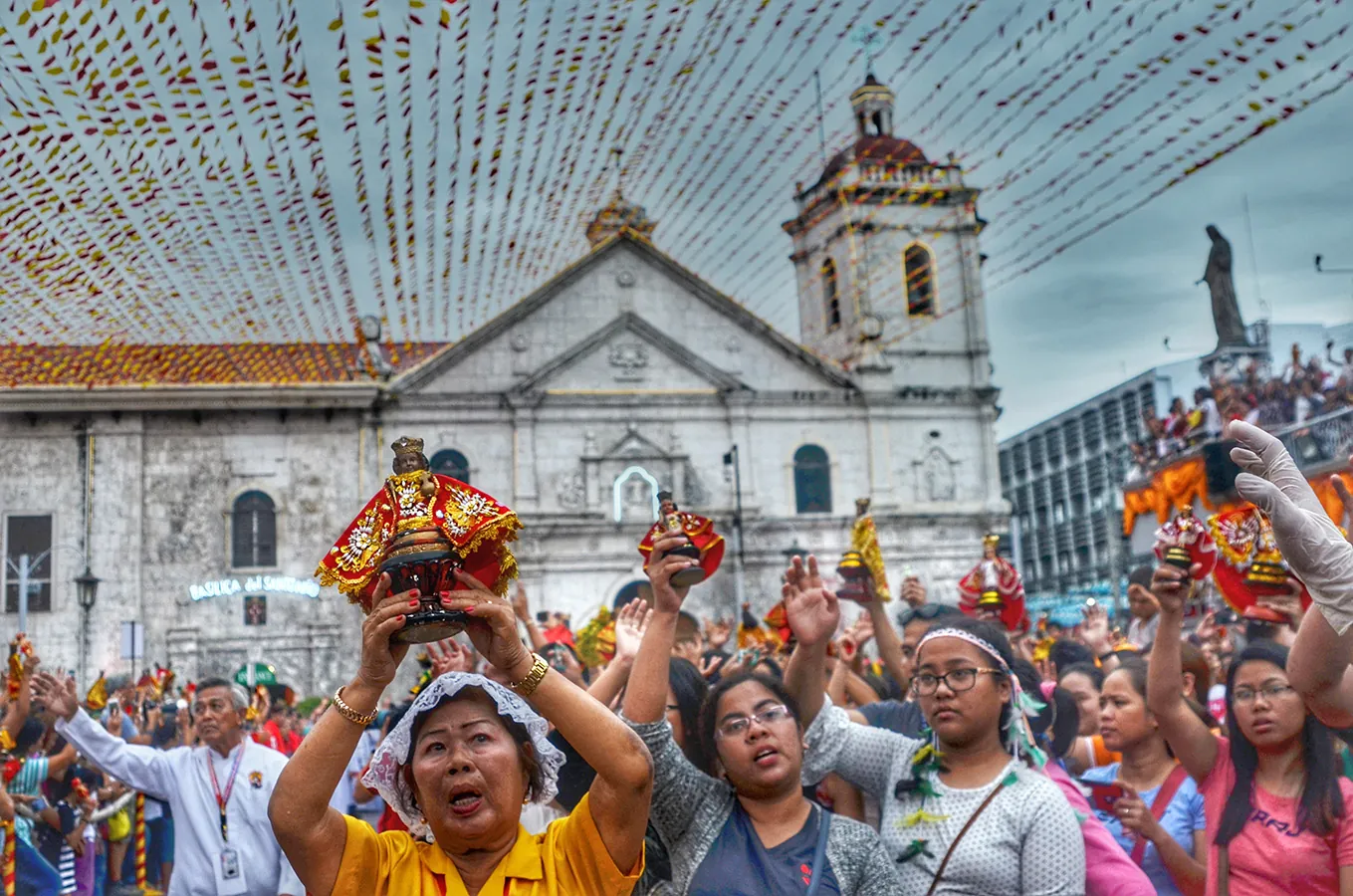
The oldest church in the country, founded by the Augustinians in 1565 on the spot where the Santo Niño was found. The present stone church dates from the 1730s. The image itself is kept in a side chapel, and there is almost always a queue of people waiting to stand in front of it for a moment. Friday is the busiest day. The pilgrim centre across the courtyard holds outdoor Masses for crowds the church cannot fit. Dress with shoulders covered; you will be asked.
Magellan's Cross
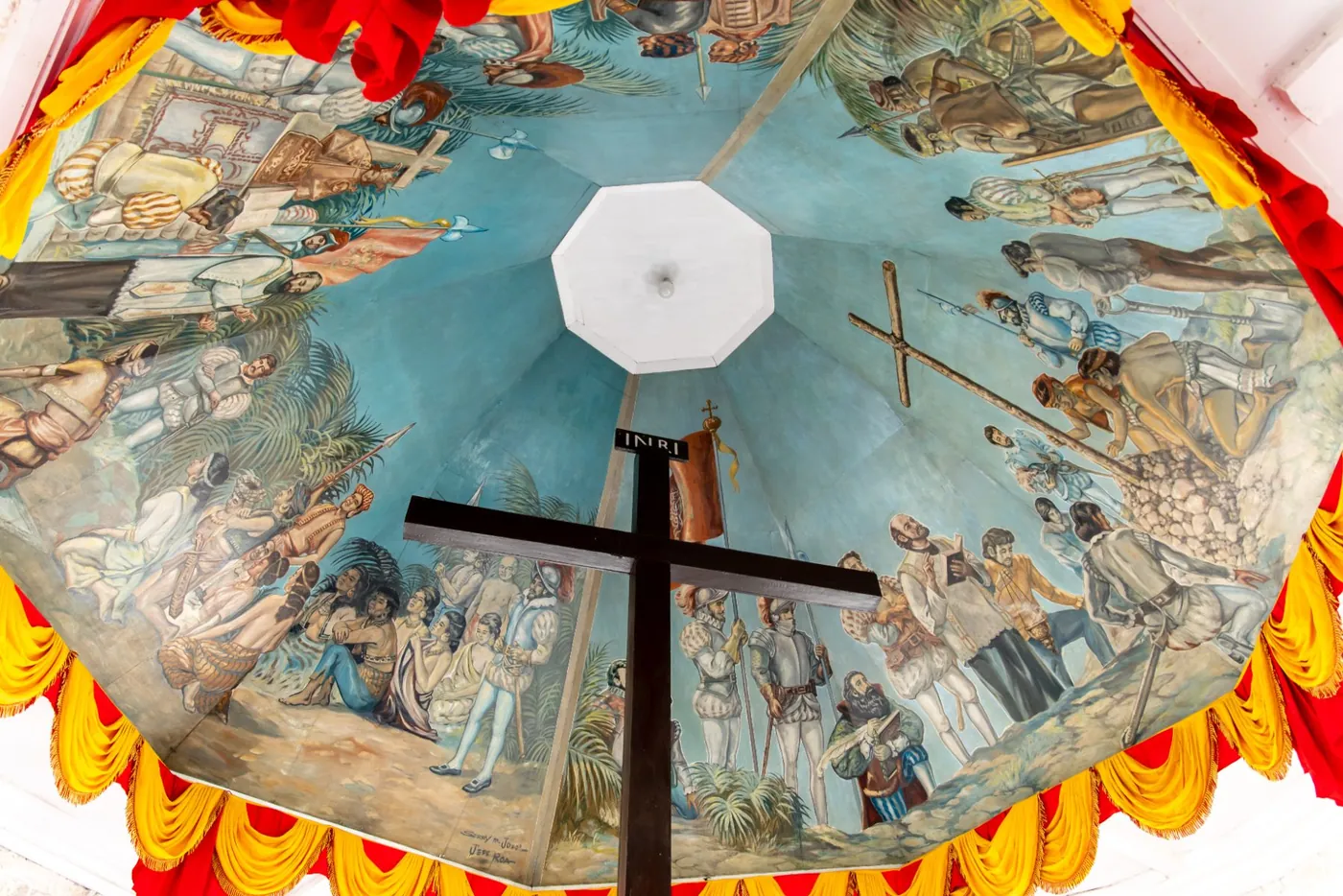
A few steps from the Basilica, in a small octagonal kiosk on Plaza Sugbo, a wooden cross stands on the ground where the expedition raised a cross in April 1521. A sign in the kiosk says the original is encased inside this one; historians have found no evidence for that, and the original is generally thought not to have survived. The painted ceiling shows the baptism. It takes five minutes and every visitor to Cebu has stood here.
Fort San Pedro
A triangle of coral-stone walls at the edge of Plaza Independencia, which the Province describes as the oldest triangular bastion fort in the Philippines. Legazpi's first fort on this site, begun in 1565, was wood; the stone you walk on is later work on the same footing. Climb the walls for the view of the port, then walk the plaza's trees back toward the old town.
Colon Street
Named for Columbus, and marked since 1961 as the oldest street in the Philippines. Cebuano historians have questioned the claim: Resil Mojares traced it to a store's advertising around 1910, and the earliest map that shows Colon dates from 1873. It is still the spine of downtown. It is loud, crowded and alive: department stores from the 1950s, the old cinemas, the ngohiong stalls, the obelisk at the top that marks its beginning. It is at its best in the late afternoon, when the stores fill up.
The Parian
The old Chinese quarter, one street back from Colon. The Heritage of Cebu Monument, a bronze-and-concrete tableau by the sculptor Eduardo Castrillo, stands in the small plaza and gathers four centuries of the city's history into one sculpture, from the arrival of the Spanish to the revolution. Around it are the houses: Casa Gorordo, a nineteenth-century home of coral stone and hardwood, now a museum of how a prosperous Cebuano family lived; the Yap–Sandiego Ancestral House, one of the oldest houses in the country, still owned and lived in by the family; and the Jesuit House of 1730, hidden inside a hardware warehouse, its date carved above the door.
Museo Sugbo
The old provincial jail, built in 1871, now the Province's museum of Cebu history, with galleries that run from the pre-Hispanic finds to the American period.
Carbon Market
The city's main public market, spread across several blocks near the pier: fruit, fish, flowers, woven goods, and at dawn, the whole of the highlands' harvest arriving by truck. Go hungry.
Cebu Metropolitan Cathedral and its small museum, the Cebu City Hall on Plaza Sugbo, and Fuente Osmeña, the fountain roundabout that marks where the old town ends and the twentieth century begins, complete the walk.
Three routes cover the old town, all on foot, all free, and all starting in the downtown core. They are drawn from the fifteen heritage sites in the City's Tourism Development Plan, grouped for walking. If you only have one morning, take the first.
The Paglantaw Route
Paglantaw is Cebuano for the act of looking, and in its second sense, for looking ahead. Seven stops, from the cross to the old provincial jail:
- Magellan's Cross
- Basilica Minore del Santo Niño
- Plaza Independencia
- Fort San Pedro
- National Museum of the Philippines – Cebu, in the old customs house
- Casa Gorordo Museum
- Museo Sugbo
Faith and Stone
The plazas and the churches, and the civic ground between them. Shorter, flatter and mostly shaded:
- Plaza Sugbo
- Cebu City Hall
- Magellan's Cross
- Basilica Minore del Santo Niño
- Cebu Metropolitan Cathedral
- Patria de Cebu
Parian
The old merchant quarter, where Chinese and Cebuano traders built houses of coral stone and hardwood, several of them still standing and still open:
- The Colon Street marker
- The Heritage of Cebu Monument
- Yap–Sandiego Ancestral House
- The Jesuit House of 1730
- Casa Gorordo Museum
Walking it with a guide
The routes are self-guided. If you want a guide, the City Tourism Office can point you to guides who hold Department of Tourism accreditation; ask, and say which route and which day.
Before you go
Walk early: in the hot months, the middle of the day is what ends walks. Carry water; there are stalls, but not on every block. The Basilica and the Cathedral are working churches, so cover shoulders and knees, keep your phone down during Mass, and let the devotees through. The pavements are coral stone and old kerbs, so wear shoes you trust.
The Highlands
The ridge behind the city climbs fast, and from the top you can see the whole story laid out: the old town at the water, the towers, the channel, Mactan, and on a clear day the mountains of Bohol and Leyte across the sea. Cebuanos go up for the air, the flowers and the view, and they go up in the late afternoon so they can watch the city light up.
Tops
The lookout on the Busay ridge, twenty minutes' drive above the city, is where the view is. Rebuilt and reopened in its present form, it has cafés, a broad terrace and a panorama from the port to the far side of Mactan. Sunset is the hour.
Sirao
Higher up the same road, the mountain barangay of Sirao grows flowers for the city's markets and now for visitors too: terraces of celosia and sunflowers in colours that look painted. Go in the morning before the clouds come over.
Temple of Leah
A vast columned memorial in the hills, built by a Cebuano businessman in memory of his late wife, and now one of the most photographed places in the city. It is unapologetically grand and the view from its steps is the reason to come.
Cebu Taoist Temple
In the Beverly Hills subdivision, built in 1972 by the city's Chinese community, with its long flight of steps and its dragon-guarded gates. It is a living temple; visit quietly.
The forest
Behind the lookouts, the ridge is still green. The Central Cebu Protected Landscape covers the watershed that gives the city its water, and in the forest of Tabunan lives the Cebu flowerpecker, one of the rarest birds on earth, thought extinct until it was found again in 1992. You will not see it without a guide, but the walk is the point.
The road across
The Transcentral Highway begins in the city and crosses the island's spine westward through pine and mist. The first half hour is Cebu City's; where it goes after that is the province's story to tell.
The Shores
Cebu City's coast is a working one, and that is its beauty. This is the harbour that received the junk from Siam and fitted the San Pedro for the voyage that found the way back across the Pacific. The trade that followed ran between Manila and Acapulco from 1571 until 1815, and Cebu had no share in it. The port still moves more domestic shipping than almost any in the country. To see it, get on the water.
The waterfront
The South Road Properties, a reclaimed stretch along the city's southern shore, is where Cebuanos go to walk, run and eat facing the sea. The promenade looks across to Mactan and, at night, along the lit line of the bridge.
The bridge
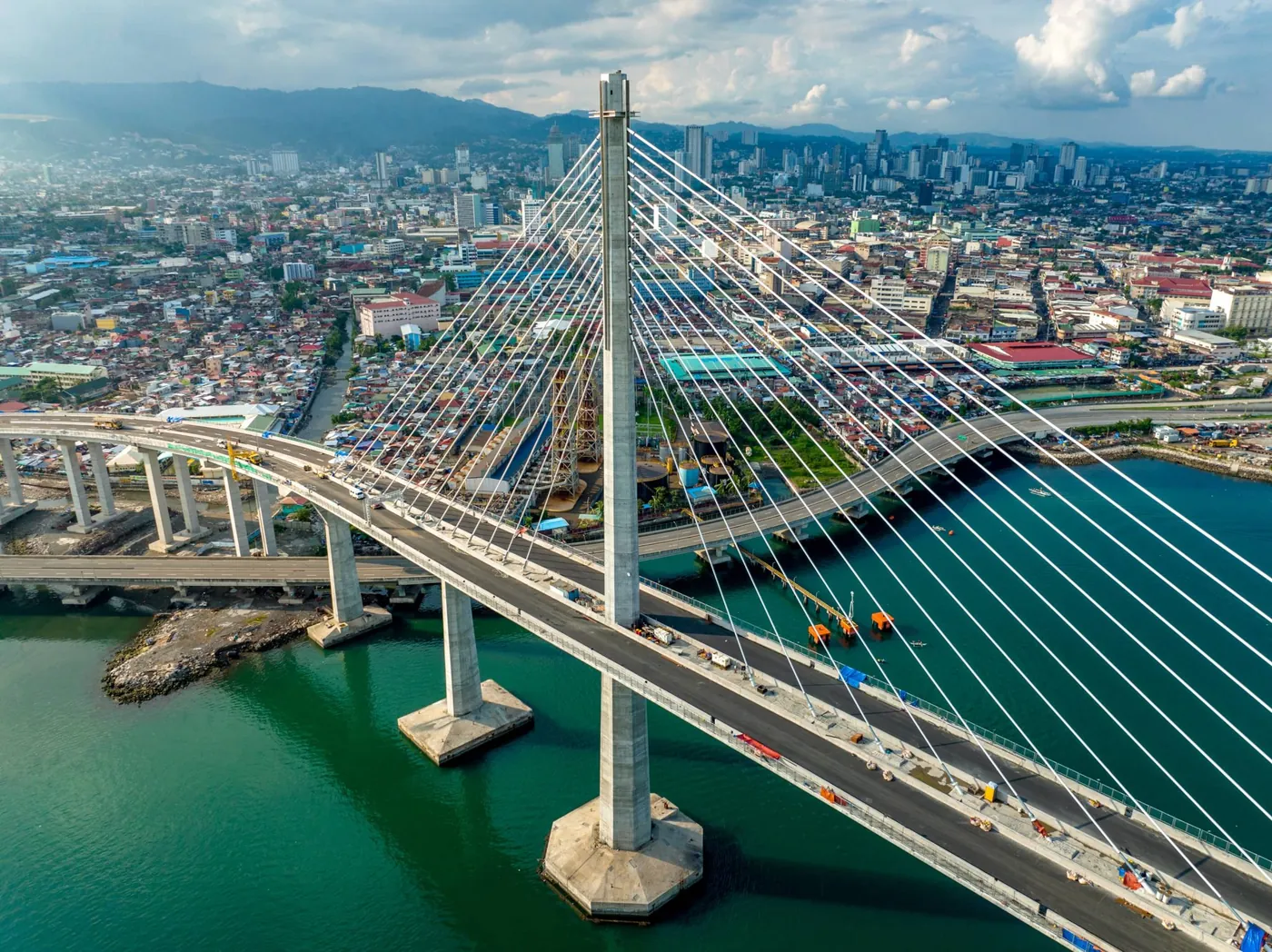
The Cebu–Cordova Link Expressway leaves the city from the SRP and crosses the channel on an 8.9-kilometre link, its cable-stayed span hung from two towers that rise like crosses over the water. Drive it at dusk; the view back at the city is the postcard.
Cebu Ocean Park
On the SRP, billed as the largest oceanarium in the country, with a walk-through tunnel under the reef tank. A half day, especially with children.
The piers
From Pier 1 to Pier 4, the city's ferries leave for every island in the Visayas: Bohol in two hours, the Camotes, Leyte, Negros. Even if you go nowhere, the piers at six in the morning, with the fast craft loading and the puso sellers working the queues, are Cebu at its most itself.
The fishing barangays
Along the coast toward Pasil and Mambaling, the bancas come in at first light with the night's catch, and the sutukil stalls open with it. This is where to eat fish the way the sea people ate it.
Sailing out
Day sails and dive trips leave from the city's marinas for the reefs and islets of the channel and beyond. Where they go is beyond this site's shore; the Province tells that part.
The Skyline
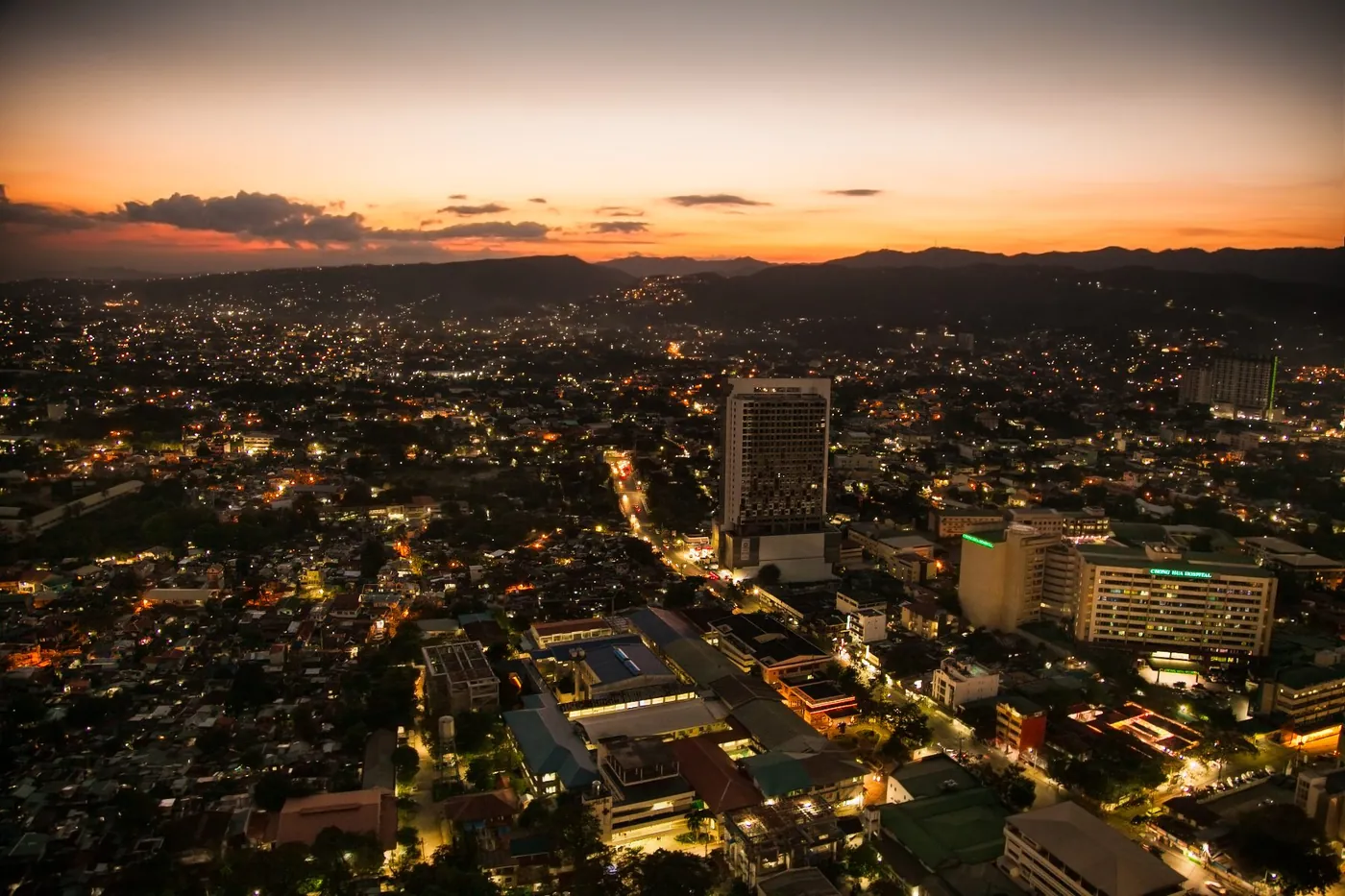
At night the city turns around. The old town goes quiet and the ridge of towers to the north lights up: Cebu Business Park, the IT Park, the hotels along the boulevard, all of it a generation old and growing every year.
Cebu Business Park
Offices, hotels and a central mall around a green park, with some of the city's tallest towers and the rooftop bars that look out over all of it.
Cebu IT Park
Ten minutes north, on the runway of the old Lahug airport, a district that never closes. The restaurants are open at three in the morning for the workers whose day is Chicago's. The food street at its centre is one of the best places in the city to eat late.
Osmeña Boulevard
The city's spine runs in a straight line from the Provincial Capitol, a 1930s building at the foot of the hills, down through Fuente Osmeña to the port. Walk it from the Capitol at dusk and you walk from the hills to the sea in forty minutes, through every century the city has.
The view from above
The best way to see the skyline is from the highlands, at Tops or from any of the ridge cafés, after dark, with the channel black and the bridge lit. It is the same view the lookouts had five hundred years ago, with lights.
Beyond the city
Cebu City is the heart of an island a hundred and ninety kilometres long, with beaches, waterfalls and whale sharks to its north and south. This site stops at the city line. The Province's own site, and the regional one, carry the rest.
The City's Table
Cebu City has fed sailors, traders, pilgrims and delegates for five hundred years, and it has never been precious about it. The best thing you eat here will probably be handed to you on a paper plate. The second best might be in the MICHELIN Guide. Both are the same city.
What the trade left on the table
A port eats what its ships bring. The food of Cebu is a thousand years of arrivals, cooked over coconut-shell charcoal.
From the sea people came the oldest habits: fish eaten raw in vinegar and calamansi, kinilaw, which Visayans were eating long before 1521; grilled fish and pork straight from the coals, sugba; rice boiled in small pouches of woven coconut leaf, puso, hung in bunches. Puso is the sea people's way of making rice portable and dry, a piece of Austronesian weaving you can eat. You tear it open with your hands, usually beside something grilled, and every barbecue stall has a bunch swinging above the coals.
From China came the noodle and the spring roll. Bam-i, two kinds of noodle in one pan; ngohiong, a five-spice roll wrapped and fried, found in Colon Street stalls and at the Carbon market; humba, the sweet braised pork that is the Cebuano cousin of the Hokkien red-cooked belly; siomai, which one district, Tisa, made its own.
From Spain came the name, not the animal. Pigs were raised and roasted on these islands long before 1521. Lechon is the Spanish word for the dish Cebu has made its own: a whole pig stuffed with lemongrass, spring onion and garlic, roasted slowly over coals until the skin shatters. Elsewhere the sauce carries the pig; here the pig carries itself, and nobody puts liver sauce on it. Nobody will stop you, but they will notice. It is fiesta food that stopped waiting for fiestas: at a roadside stall at ten in the morning, by the kilo for the plane, or at a table with linen.
From the sun came the mango. Dried mango is what visitors carry home from here by the kilo.
And from the city's own streets came the things nobody planned. Tuslob buwa, born in the Pasil district: a pan of pork brain and liver bubbling on a burner, into which everyone at the table dips their puso. Larsian, the open-air barbecue strip near Fuente Osmeña, where a skewer and a puso is a full dinner. Danggit, dried rabbitfish from the Taboan market, fried crisp for breakfast. At the shore, the sutukil stalls, where you choose your fish from the ice and say how you want it: sugba, grilled; tuwa, in soup; kilaw, raw.
Carbon, before dawn
Carbon is generally reckoned the city's oldest public market and its largest, and it is the place to understand what Cebu City actually eats. It was trading under Spanish rule and it is trading now. The name is younger than the market: it is usually traced to the coal stored there in the early American period for the railway that once ran down the island. Before dawn and just after is the market at full speed: fish still moving, mountains of mango and calamansi, the dried-fish aisle you smell before you reach it. By mid-morning it is a slower place.
In the guide
The MICHELIN Guide published its first Philippine selection in October 2025, as its 2026 edition, covering Manila and its environs, and Cebu. Eighteen places in Cebu were named, and thirteen of them have a Cebu City address. None holds a MICHELIN Star. All six of Cebu's Bib Gourmands, the guide's mark for good cooking at a good price, are in Cebu City, which is a very Cebuano thing to be recognised for. The guide updates every year; where this page and the guide disagree, the guide is right.
Up the mountain
Cebu City runs from the harbour to the ridge, and its upland barangays, among them Sudlon II, Lusaran, Tabunan and Budlaan, grow a good part of what the city eats. Shortening the road between those farms and the city's kitchens is one of the aims of the City's Tourism Development Plan.
How to eat here
Eat with your hands. Order more puso than you think you need. Say yes to the dinuguan. Ask the person next to you what they are having, and expect them to share it. Breakfast is danggit and rice, or puto and sikwate, rice cakes and hot chocolate, near the churches. The barbecue strips light up at dusk, and the sutukil stalls on the shore keep the fishermen's hours.
The city's great season, and the rest of its calendar, is the next part of the story.
Continue to
Sinulog