
Verified by the Cebu City Tourism Commission · every fact names its source below
- 01KagahaponYesterday. Our story did not begin with a ship from Spain. It began with our own ships, our own traders, our own sea.
- 02KaronToday. One thousand years later, Cebu is still the Sinibuay’ng Hingpit, the perfect trading place, now a global port.
- 03KaugmaonTomorrow. Cebu to the World is an offering, and a question. It is a story being written, and we invite you to write it with us.
Before the first map
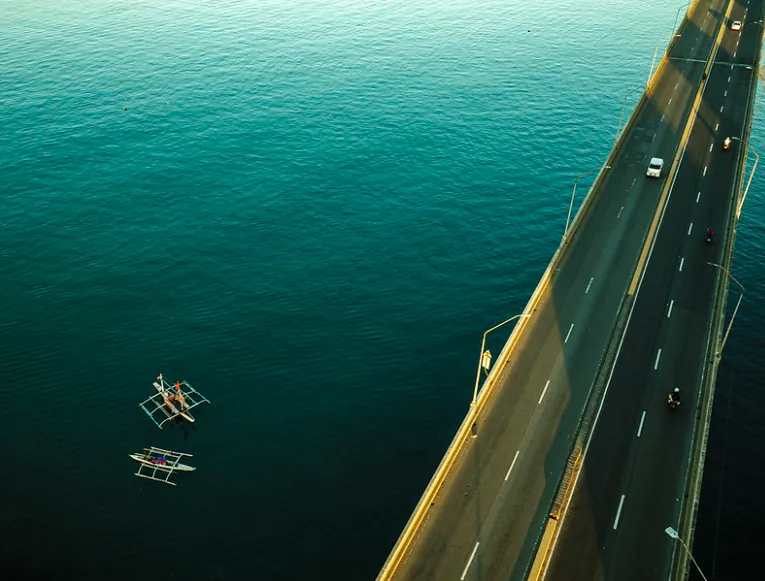
Stand on the waterfront of Cebu City at dawn and look east across the channel. The light comes up over Mactan and the water turns from grey to blue. Ships are already moving. They have been moving here, in and out of this harbour, for longer than any written record can say.
The year a Spanish fleet found the harbour sits near the middle of this story, not at its beginning. To understand why Cebu became the place where the world's two halves met, you have to go back much further: to the first sea people, to boats that bent with the waves instead of breaking, and to a port that traded with China and the kingdoms of Southeast Asia centuries before any European ship reached it.
This is that story, told in order.
The story in order
Eighteen moments, and 1521 is where the story turns
Ancient Maritime Trading
The oldest line
Begin with the people. In 2021, a study in the journal Current Biology found that the Ayta Magbukon of Luzon carry the highest level of Denisovan ancestry of any living population, higher than anyone in Oceania. The Denisovans were an ancient human group, and their clearest surviving trace in any people alive today runs through these islands. Whatever else is true here, people have lived and moved through this archipelago for a very long time.
The sea people
Around four thousand years ago a new people began to move south from Taiwan into the Philippines. They spoke early forms of the Austronesian languages, and they were sailors. Over the centuries that followed, their descendants carried those languages east across the whole Pacific, to Guam, Fiji, Hawaii, Easter Island and New Zealand, and west across the Indian Ocean to Madagascar, off the coast of Africa. It is the widest spread of any language family in human history before the modern age, and the Philippines sits at its hinge. The Cebuano spoken in this city today belongs to that family. So do Malagasy, Hawaiian and Māori.
These were people who navigated by the stars, by the swells and by the birds, without instruments. The sea was not a barrier to them. It was the road. As it was put in the room where this site was planned: the connection was through the sea; the sea was a highway.
The Visayans of these islands were also marked people. The Spaniards who arrived in the sixteenth century called them Pintados, the painted ones, because the men wore their rank and their voyages in tattoo across their bodies. The same craft of tattoo runs through the Pacific cousins of the Visayans, from Samoa to the Marquesas to Aotearoa. The Commission's reading is that this is a family resemblance, not a coincidence. The tattooing of the Cordillera peoples in northern Luzon is part of the same Philippine inheritance, and it is still practised today.
Boats older than the Vikings'
At Butuan, on the river mouths of northern Mindanao, archaeologists have dug up a fleet. The boats are called balangay. The oldest of them has been carbon-dated to about 320 AD, centuries before the first Viking longship put to sea. They are built plank by plank, edge-pegged and lashed to the ribs with fibre, so that the hull flexes when a wave hits it instead of splitting. It is a technology made for open water, and the same idea — a hull that gives rather than fights — is still working in the outriggers crossing the channel today.
The Cebuanos who met the Spanish fleet in 1521 had a warship of their own, the caracoa, a large, fast outrigger built for raiding and for carrying goods across the Visayan sea. A full-size caracoa is planned to stand beside a galleon at the NuStar Grand Theater expo hall; the pairing and its dates are still to be confirmed.
The port called Sugbo
By the tenth century, and probably earlier, the settlement the locals called Sugbo was a working port in a trading world that stretched from China to India. Chinese trade ceramics have come out of the ground across the Visayas. Then, in 1225, a Chinese record that may name Cebu: Zhao Rugua, the superintendent of maritime trade at the port of Quanzhou, wrote down the foreign places his merchants traded with in the Zhufan Zhi, and among them is one he calls Suwu. Scholars call the Cebu identification plausible, not certain. Traders came from the Champa kingdoms of what is now Vietnam, from Siam, and from the Srivijaya sphere of Sumatra and Java. Gold, wax, cotton, pearls and turtle shell went out. Porcelain, iron, silk and glass came in.
The islands did not only receive. They sent. Butuan sent tribute missions to the Song court at Kaifeng in 1001 and again in 1011, and the Chinese annals recorded them. Four centuries later, in 1417, a ruler from these islands, Paduka Pahala, the East King of Sulu, led a mission to the Ming court. He died on the journey home. The emperor buried him with honours at Dezhou in Shandong province. His tomb is still there, tended by descendants who have lived in China for six hundred years.
This is the world Sugbo belonged to before a single European had seen it: a port with foreign ships in the harbour, a chieftain who received envoys, a people whose boats had already crossed oceans.
Why there are no temples
Visitors sometimes ask why a civilisation this old left no stone temples, no Angkor, no Borobudur. The Commission's answer, and one that historians offer alongside others, is that this is a country on the Ring of Fire, crossed by tropical storms every year. A people who build in stone here rebuild forever. A people who build in wood, bamboo and thatch build again by next season. The Visayans chose to put their genius into things that move: boats, textiles, gold, tattoo, song. What they built was made to flex, like the balangay.
The First Circumnavigation
A world divided
In 1494, at Tordesillas in Spain, the two great sea powers of Europe divided the unknown world between them with a line down the Atlantic, brokered by the Pope. Portugal took everything east of the line: the route around Africa to India and the trade of the Indian Ocean. Spain took everything west. Where the line fell on the far side of the world, and so who held the Spice Islands of the Moluccas, stayed in dispute until 1529. If Spain wanted the spices, it had to sail the other way around the world, and nobody knew how far that was.
Five ships
A Portuguese captain named Fernão de Magalhães, whom the Spanish called Magellan, believed he knew. He had served in Malacca, and he had bought there a young Malay slave he named Enrique, who spoke the language of the islands. Sailing under the Spanish crown, Magellan left Seville with five ships in August 1519, and in September 1519 the fleet cleared Sanlúcar de Barrameda for the Atlantic. The flagship was the Trinidad. Enrique was aboard as interpreter. Also aboard was a Venetian scholar, Antonio Pigafetta, who kept the diary that tells us most of what follows.
They lost two ships at the bottom of South America. The Santiago wrecked. The San Antonio turned and sailed home. With three, Magellan found the strait that now carries his name and came out into an ocean so calm after the storms of the Atlantic that he named it Mar Pacífico, the peaceful sea. The crossing nearly killed them. For three months they found no island they could provision at, and the food ran out; the men ate leather, sawdust and rats.
Landfall
On 6 March 1521 they reached Guam and were met with hostility; they took on little and left. On 16 March they sighted Samar and anchored at the small island of Homonhon, where the people were kind and brought food and water. From there they moved to Limasawa, where on 31 March 1521 the first Mass in the islands was said on the shore.
At Limasawa something happened that is easy to pass over and that this site will not. Enrique spoke, and the local ruler, Rajah Colambu, understood him. After a year and a half at sea, after crossing an ocean whose size nobody in Europe had guessed, the expedition's interpreter had come back into the reach of his own tongue. The first words to travel all the way around the world were Malay, spoken in the Visayas. Colambu told them where the trade was. He said the name: Sugbo. He offered to pilot them there himself.
7 April 1521
The fleet entered Cebu harbour on 7 April 1521. As Pigafetta tells it, there was already a foreign ship at anchor: a junk from Siam, loading and trading. On the day Europe arrived, Cebu had international shipping in its harbour. The Spaniards had not discovered a port. They had found one.
The ruler of the port was Rajah Humabon. Through Enrique, the two sides talked. Pigafetta records the gold of the islands, worn and traded freely, and the captain's order to his men not to show how much they wanted it, so as not to raise its price. As Pigafetta tells it, the crew traded mirrors and trinkets for gold and were amazed at the exchange.
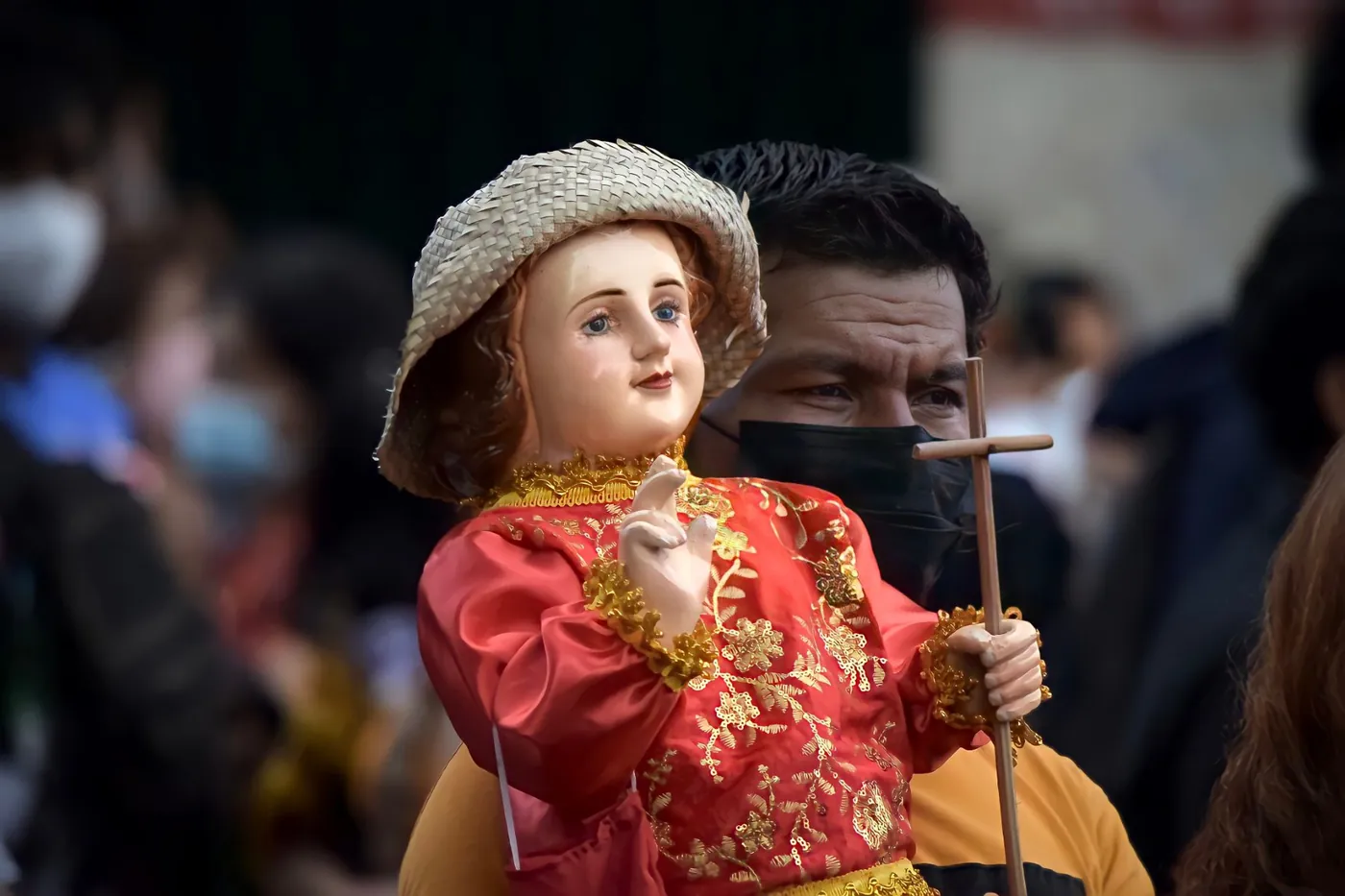
On 14 April 1521 Humabon and his queen, given the name Juana, were baptised, and hundreds of their people with them. Magellan gave the queen a small carved image of the Christ Child. It is the Santo Niño de Cebu, the oldest Christian relic in the Philippines, and it is still here, a short walk from where the fleet dropped anchor. What happened to it in the years between belongs further down this page.
Mactan
Thirteen days later, on 27 April 1521, Magellan was killed on the shore of Mactan, across the channel, in a battle with the men of the chieftain Lapu-Lapu. He had gone to war in a local dispute. He died as a combatant, in a fight between rulers.
It is sometimes said, as a joke, that Mactan killed the first tourist. The Commission wants that line retired. Cebu had been receiving foreign traders for centuries before 1521. Magellan was not the first visitor. He was the first European, and he did not come as a guest.
One ship home
The survivors left Cebu in three ships. Days later, off Bohol, with too few men to sail all three, they burned the Concepción. Of the two that remained, only the Victoria, under Juan Sebastián Elcano, chose to keep going west, across the Indian Ocean and around Africa. She reached Spain in September 1522 with eighteen men aboard, three years after leaving with about two hundred and seventy.
It was the first voyage around the world. It did not prove the earth was round; educated Europe already knew that. What it proved was the earth's true size, that the oceans connect, and that a ship leaving one side of the world could come home from the other. Cebu was on that line. The route that joined the halves of the earth ran through this harbour.
A Portuguese ambassador visiting Cebu years ago said something to Tetta Baad, a Commissioner of the City's Tourism Commission, that she has never forgotten: it is sad that Cebu does not seem to appreciate its role in world history. This site is, in part, an answer to him.
East Meets West
The return
The Spanish did not forget the islands. Expeditions failed for four decades. Then, in 1565, forty-four years after Magellan, Miguel López de Legazpi anchored in the same harbour, fought Rajah Tupas for the settlement, and built the first Spanish town in the Philippines on its ashes. He raised a wooden fort that became Fort San Pedro. In the ruins of a burned house, one of his soldiers found the Santo Niño, unharmed. The Augustinians built a church on the spot. It is the Basilica Minore del Santo Niño, and the image is venerated there today.
That same year, in this harbour, one of the great problems of the age was solved. Ships could sail west from Mexico to Asia on the trade winds; nobody had found a way back. The San Pedro, refitted at Cebu, sailed east in June 1565 with the friar-navigator Andrés de Urdaneta aboard, went north to catch the westerlies, and reached Acapulco in October. The way home across the Pacific had been found, from Cebu. The trade that followed ran between Manila and Acapulco from 1571 until 1815, and Cebu had no share in it.
Two halves of a world
This is the meeting that gives the brand its name. For a thousand years the ports of these islands had traded east and west with Asia. In 1521 and 1565 the sea road of the Spanish empire, running from Seville through Mexico, reached the same harbour. Two trading worlds that had never touched met here. That is what the brand's name records: not a prize Cebu won, but a crossing that happened in this water.
The long silence
What followed was three centuries of Spanish rule, and this site is honest about what that cost. The tattoos of the Pintados were discouraged until they vanished. The old faith was replaced. The records of the past, where they existed, were not kept. Much of what we know today about pre-Hispanic Cebu comes from Chinese chronicles and from the archaeologists' trowel, not from our own written memory. The Commission's reading is that this was, in part, a deliberate erasure, and that recovering the older story is a work of restoration, not invention. The science of the last twenty years, in genetics and archaeology, has been on the side of that restoration.
Cebu is the oldest Spanish-founded city in the Philippines. The Commission is proud of that, and chose not to open with it, because it is not where the story begins.
What each age left
Commissioner Baad's own summary is the one this site keeps. The Spaniards brought the faith, and the Philippines became, with Timor-Leste, one of the two predominantly Christian nations of Southeast Asia, with the seed planted here. The Americans, after 1898, brought English, which made Cebuanos at home in the wider world. Both were later chapters in a story that was already long.
What the story leaves us
A people who crossed oceans without instruments. A port that received foreign ships before Europe knew it existed. A harbour where the sea roads of Asia and of Europe met, and from which the way home across the Pacific was found. Three centuries of quiet, and a rediscovery that is still under way.
The Cebuanos of today are the descendants of all of it: the sea people, the traders, the ones who were baptised and the ones who fought, the ones who kept the old songs. That is where the next part of this story goes: to the people.
Continue to
People